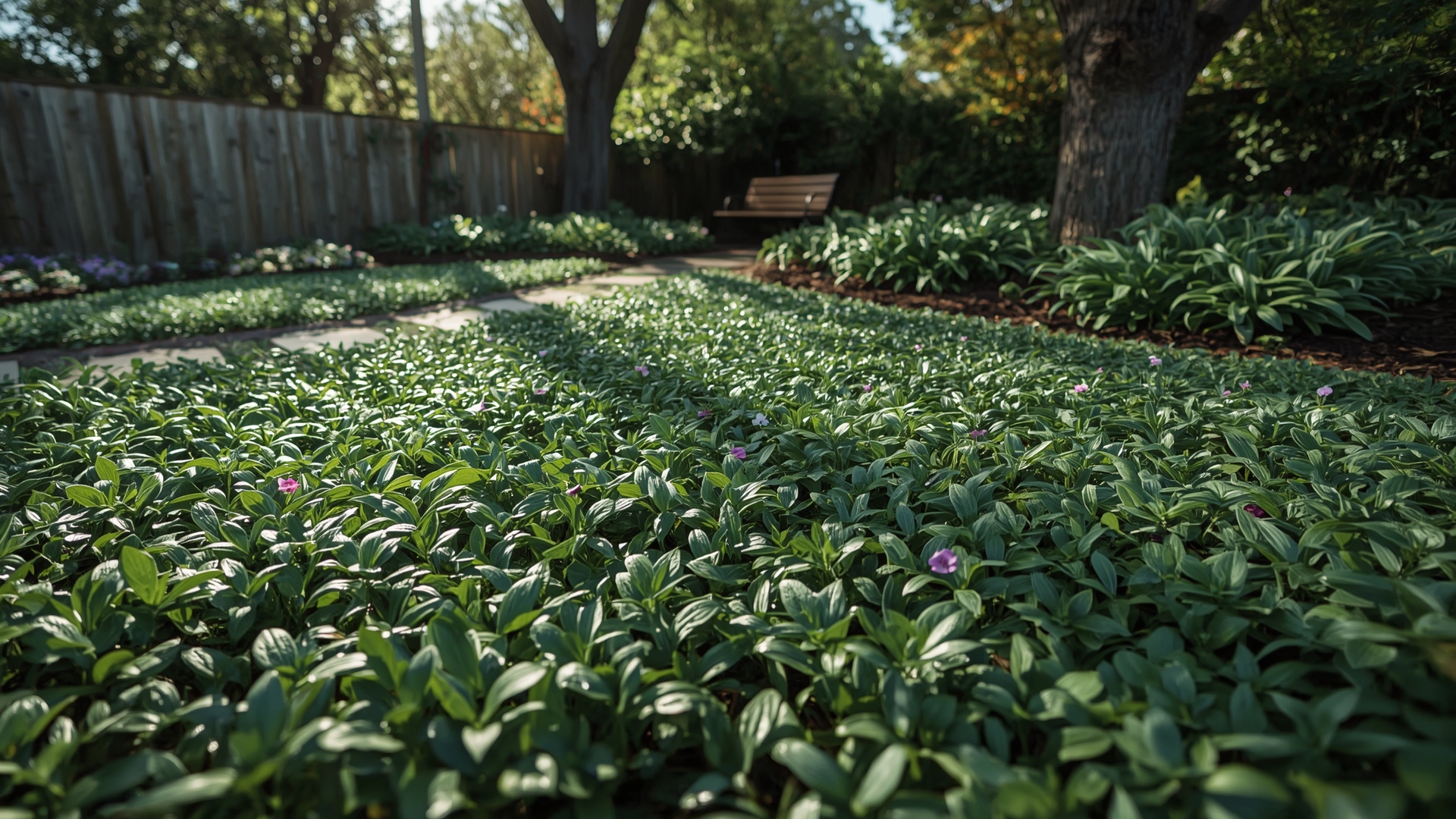
A traditional lawn demands a lot. Weekly mowing, regular fertilizing, consistent watering, and ongoing weed control can eat up hours of your time and hundreds of dollars each year. Ground cover plants offer a different path. They spread across bare soil, crowd out weeds, and create a living carpet that largely takes care of itself once established.
Whether you’re dealing with deep shade, steep slopes, poor soil, or simply lawn fatigue, there’s a ground cover plant suited to your situation. This guide covers the best options, how they grow, what they need, and how to choose the right one for your yard.
Key Takeaways
- Creeping thyme handles full sun and foot traffic better than most ground covers, spreading 12–18 inches per plant within two growing seasons.
- Pachysandra is the go-to choice for dense shade where grass won’t grow, covering up to 12 square feet per plant over three years.
- Ajuga (bugleweed) spreads aggressively through runners, reaching 6–9 inches wide per plant in a single season — ideal for fast coverage.
- Sedum mat varieties tolerate drought and poor soil better than any other ground cover on this list.
- Most ground covers require minimal maintenance after the first establishment year, which typically involves regular watering and occasional weeding.
- Ground covers reduce lawn care costs by eliminating the need for mowing and significantly cutting water and fertilizer use.
What Makes a Plant a Good Lawn Alternative Ground Cover?
Quick Answer: A good lawn alternative ground cover spreads horizontally to fill space, stays low (under 12 inches), suppresses weeds by blocking sunlight, tolerates your site’s conditions, and requires less maintenance than grass once it’s established.
Not every low-growing plant qualifies. The best lawn alternatives share a few key traits. They spread reliably without becoming invasive nightmares. They stay dense enough to block weed seeds from germinating. They recover when you walk through them occasionally, or they simply don’t need to be walked on at all.
The right plant also matches your site. A sun-loving variety planted in shade will thin out and invite weeds. A moisture-hungry plant on a dry slope will struggle to establish. Matching plant to place is the most important decision you’ll make.
What Traits Separate Successful Ground Covers from Failures?
Successful ground covers have a few things in common. They root quickly after transplanting. They produce enough foliage density to shade the soil underneath. They spread through stolons (above-ground runners), rhizomes (underground stems), or self-seeding — ideally without escaping into neighboring areas.
Failures tend to happen when plants are spaced too far apart during planting, leaving bare soil that weeds colonize before the ground cover fills in. Temporary mulch between plants during the establishment phase solves this problem.
How Does Creeping Thyme Perform as a Lawn Replacement?

Quick Answer: Creeping thyme works well as a lawn replacement in full sun. It spreads 12–18 inches per plant, tolerates light foot traffic, blooms purple-pink in early summer, and needs almost no water once established. It won’t work in shade or heavy clay.
Creeping thyme (Thymus serpyllum and Thymus praecox) is one of the most popular grass alternatives for sunny yards. It stays under 3 inches tall, releases a pleasant herbal scent when brushed, and produces a carpet of tiny pink or purple flowers each June.
It thrives in poor, well-drained soil — the kind of conditions where grass struggles. Rich, moist soil actually weakens it. If your yard has sandy or gravelly soil with full sun exposure, creeping thyme may outperform every other option on this list.
What Are the Limitations of Creeping Thyme?
Creeping thyme has real limits. It won’t tolerate shade, poorly drained soil, or heavy foot traffic (occasional stepping is fine, daily walking paths are not). It also establishes slowly in its first season. You’ll need to water it consistently and pull weeds by hand until it fills in, usually in year two.
In cold climates (USDA Zones 4 and below), some varieties may thin out significantly after harsh winters, requiring spring patching.
Is Ajuga (Bugleweed) a Fast-Spreading Lawn Alternative?
Quick Answer: Yes. Ajuga is one of the fastest-spreading ground covers available. Each plant spreads 6–9 inches in a single growing season through surface runners. It grows in sun or part shade and produces blue flower spikes in spring.
Ajuga reptans, commonly called bugleweed, earns its place as a lawn alternative through sheer coverage speed. Plant it in spring, and by fall you’ll have a noticeably denser mat. By the second year, gaps between plants disappear entirely.
It tolerates a wider range of conditions than creeping thyme — including part shade and moderately moist soil. Varieties like ‘Chocolate Chip’ (narrow, brown-tinted leaves) and ‘Burgundy Glow’ (variegated pink and cream) add ornamental interest beyond just coverage.
Does Ajuga Become Invasive?
Ajuga can spread beyond its intended area, particularly into lawn edges, garden beds, or neighboring yards. It’s not classified as invasive in most U.S. states, but its runners require periodic edge trimming — about once or twice per year — to keep it contained.
It’s not a plant you install and completely ignore. The maintenance is low compared to grass, but not zero. Think of it like a plant that asks for a yearly boundary conversation instead of weekly mowing.
Where Does Pachysandra Work Best as a Ground Cover?
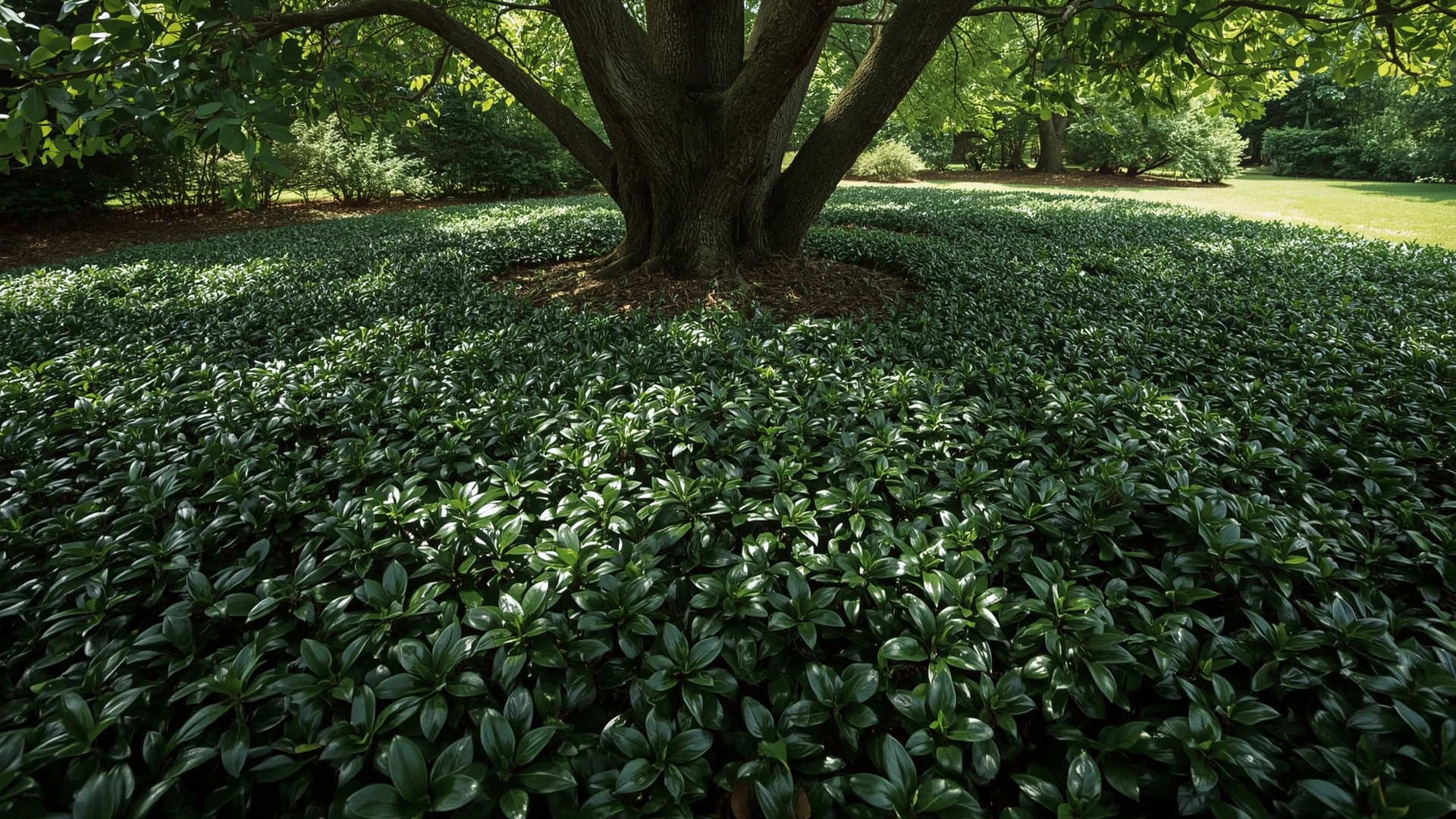
Quick Answer: Pachysandra works best in dense shade under trees or along north-facing foundations. It covers up to 12 square feet per plant over three years, stays evergreen in Zones 4–9, and is one of the few ground covers that actually thrives in dry shade.
Pachysandra terminalis is the workhorse of shady ground covers. It grows where grass simply won’t — under mature trees, along foundation walls that face north, and in spots that receive fewer than three hours of direct sunlight daily.
It spreads through underground rhizomes at a moderate pace. It won’t give you full coverage in year one, but by year three it forms a dense, weed-suppressing mat that rarely needs attention. Its glossy, dark green leaves stay on the plant year-round in most climates.
What Conditions Does Pachysandra Struggle With?
Full sun is pachysandra’s main weakness. Direct afternoon sun scorches its leaves, turning them yellow and papery. It also performs poorly in alkaline soil — it prefers a slightly acidic pH between 5.5 and 6.5.
In humid climates, pachysandra can develop a fungal disease called Volutella blight, which causes brown blotches and die-back. Thinning overcrowded patches and improving air circulation reduces the risk significantly.
How Well Do Sedum Mat Varieties Handle Tough Growing Conditions?

Quick Answer: Sedum mat varieties handle drought, poor soil, and heat better than most ground covers. Low-growing types like Sedum acre and Sedum spurium stay under 4 inches tall, spread 12–24 inches per plant, and survive in rocky or sandy soil with minimal water.
Sedum (stonecrop) is the drought-tolerance champion of ground cover plants. Once established, most low-growing sedum varieties need almost no supplemental water. They store moisture in their succulent leaves, which allows them to coast through dry spells that would stress other plants.
Sedum acre (goldmoss stonecrop) forms a bright green mat dotted with yellow flowers in late spring. Sedum spurium varieties like ‘Dragon’s Blood’ develop red-tinged foliage that deepens in color as temperatures cool in fall, adding year-round visual interest.
What Are the Best Sedum Varieties for Ground Cover Use?
Not all sedums stay low. Tall border sedums like ‘Autumn Joy’ grow 18–24 inches high and don’t work as lawn replacements. For ground cover use, stick to creeping or mat-forming types that stay under 6 inches.
Sedum kamtschaticum, Sedum reflexum (blue spruce stonecrop), and Sedum rupestre ‘Angelina’ are reliable performers. ‘Angelina’ is particularly popular for its golden-yellow foliage that turns orange in cooler weather.
Which Ground Cover Plants Work in Deep Shade?
Quick Answer: Pachysandra, sweet woodruff, wild ginger, and liriope are the strongest performers in deep shade. Each tolerates under three hours of direct sun daily. Sweet woodruff and wild ginger also handle dry shade under mature tree canopies.
Deep shade is one of the hardest landscaping problems to solve. Grass fails completely. Most flowering ground covers thin out. But a few plants have evolved specifically for low-light environments and actually struggle in direct sun.
Sweet woodruff (Galium odoratum) spreads through rhizomes and produces delicate white flowers in spring. Wild ginger (Asarum canadense) has large, heart-shaped leaves that create a lush, tropical-looking carpet. Liriope (lilyturf) is nearly indestructible in shade, tolerating drought, salt spray, and foot traffic better than most alternatives.
Can Hostas Work as Ground Cover in Shade?
Large hosta varieties don’t spread fast enough to function as lawn replacements. However, small, spreading varieties like ‘Halcyon’ or ground-hugging types planted at 12-inch spacing can create effective shade coverage over time.
Hostas are better described as mass-plantings than true ground covers. They die back in winter, leaving bare soil exposed until spring regrowth. In most cases, pachysandra or sweet woodruff offers better year-round coverage in shaded areas.
What Ground Cover Plants Tolerate Sun and Drought?
Quick Answer: Creeping thyme, sedum mat varieties, ice plant, and woolly thyme handle full sun and drought best. These plants need well-drained soil and minimal irrigation after their first establishment season of 8–12 weeks with regular watering.
Hot, dry yards in full sun present the opposite challenge from shade. Here, the risk is establishing plants during summer heat before they’ve developed enough root depth to handle dry spells.
Ice plant (Delosperma species) is an underused option for dry, sunny slopes in Zones 5–10. It spreads 12–18 inches per plant, produces vivid magenta or yellow flowers throughout summer, and handles heat that would wilt other ground covers.
Woolly thyme (Thymus pseudolanuginosus) grows even shorter than creeping thyme — just 1–2 inches tall — and creates a soft, fuzzy-textured mat that tolerates stepping stones and occasional foot traffic surprisingly well.
How Do Ground Cover Plants Compare to Traditional Grass?
Quick Answer: Ground cover plants generally cost more upfront than grass seed but cost less over time. They eliminate mowing and reduce irrigation needs by 30–60% once established. Most require minimal fertilizer and no herbicide applications after the first year.
The comparison isn’t as simple as “ground covers are better.” It depends on your priorities, your budget, and how you use your yard. Grass still makes sense in areas where kids and pets play heavily, or where you need a flat, uniform surface for activities.
Where ground covers clearly win: shaded areas, slopes prone to erosion, areas with poor or rocky soil, and any spot where you want to reduce weekly maintenance without sacrificing a planted look.
Ground Cover vs. Grass: At-a-Glance Comparison
| Factor | Traditional Grass | Ground Cover Plants |
|---|---|---|
| Mowing required | Weekly (spring/fall) | None to annual trim |
| Watering needs | 1–1.5 inches per week | 0.25–0.75 inches per week (established) |
| Fertilizer frequency | 2–4 times per year | 0–1 times per year |
| Establishment time | 4–8 weeks from seed | 1–3 growing seasons |
| Foot traffic tolerance | High | Low to moderate (varies by species) |
| Shade performance | Poor to fair | Excellent (with right species) |
| Slope/erosion control | Moderate | Good to excellent |
How Do You Choose the Right Ground Cover for Your Yard?
Quick Answer: Match your ground cover choice to three factors: light level (full sun, part shade, or deep shade), soil drainage (well-drained vs. moist), and intended use (aesthetic coverage vs. foot traffic zones). These three filters narrow your options quickly.
Start with a site assessment before buying a single plant. Stand in the area at different times of day and count hours of direct sun. Check whether water puddles after rain or drains away within an hour. Note whether you need the area to handle occasional walking.
Once you know your conditions, use the EAV table below to match options to your site. This prevents the most common mistake: buying a plant that looks good at the nursery but fails in your specific conditions.
Ground Cover Plant Comparison by Site Condition
| Plant | Light Requirement | Soil Preference | USDA Zones | Spread Rate | Foot Traffic |
|---|---|---|---|---|---|
| Creeping Thyme | Full sun (6+ hrs) | Well-drained, lean | 4–9 | 12–18 in/season | Light |
| Ajuga (Bugleweed) | Part shade to sun | Moist, well-drained | 3–9 | 6–9 in/season | None |
| Pachysandra | Part to deep shade | Moist, acidic | 4–9 | Slow (12 sq ft/3 yrs) | None |
| Sedum (mat types) | Full sun | Sandy, rocky, dry | 3–9 | 12–24 in/season | None to light |
| Sweet Woodruff | Part to deep shade | Moist, humus-rich | 4–8 | 12 in/season | None |
| Liriope | Sun to deep shade | Adaptable, any | 5–10 | 6–8 in/season | Light |
| Ice Plant | Full sun | Sandy, dry, alkaline OK | 5–10 | 12–18 in/season | None |
| Wild Ginger | Part to deep shade | Rich, moist | 3–7 | 6–12 in/season | None |
How Do You Plant and Establish Ground Cover Successfully?
Quick Answer: Plant ground covers in spring or early fall, space them according to their mature spread, apply 2–3 inches of mulch between plants, and water consistently for the first 8–12 weeks. Proper spacing and temporary mulch are the two most important establishment factors.
The biggest establishment mistake is spacing plants too far apart to save money. Wider spacing means more bare soil, more weed pressure, and more hand-weeding before coverage fills in. Closer spacing costs more upfront but dramatically reduces the work required in year one.
As a general rule, aggressive spreaders like ajuga can go 8–12 inches apart. Moderate spreaders like sweet woodruff do well at 12–15 inches. Slow spreaders like pachysandra need to go 6–8 inches apart to achieve reasonable coverage within two to three seasons.
Step-by-Step Ground Cover Planting Process
- Remove existing vegetation. Kill or smother existing grass and weeds completely before planting. Smothering with cardboard and mulch (sheet mulching) for 8–12 weeks is an effective, chemical-free option.
- Amend the soil if needed. Most ground covers prefer slightly improved soil. Work in 2–3 inches of compost if your soil is compacted or very poor. Sedum and creeping thyme are exceptions — they prefer lean soil.
- Dig and plant at proper spacing. Set plants at the same depth they were growing in their nursery containers. Planting too deep invites crown rot.
- Mulch between plants. Apply 2–3 inches of wood chip or shredded bark mulch between plants immediately after planting. This suppresses weeds while the ground cover spreads to fill the gaps.
- Water deeply after planting. Soak the entire area at planting, then water 2–3 times per week for the first 4 weeks, tapering to weekly watering through the rest of the first season.
- Pull weeds as they appear. Hand-pull weeds during the establishment period before they compete with young plants or set seed.
What Maintenance Do Ground Cover Plants Actually Require?
Quick Answer: After the first establishment year, most ground covers need edge trimming once or twice a year, occasional hand-weeding if gaps appear, and light watering during extended dry spells. Some benefit from a light shearing after flowering to promote denser growth.
The maintenance story changes dramatically after year one. The heavy lifting — watering, weeding, monitoring — concentrates in the establishment phase. Once a ground cover has knitted together into a continuous mat, it does most of the work itself by shading out weed seeds and holding soil moisture.
Edge management is the most consistent ongoing task. Plants like ajuga and creeping thyme will spread into lawn areas, garden beds, or hardscape cracks if you don’t trim the edges back annually. A sharp spade or power edger handles this in 20–30 minutes per year.
Seasonal Maintenance Calendar for Ground Cover Plants
| Season | Task | Plants It Applies To | Time Required |
|---|---|---|---|
| Early Spring | Cut back winter-damaged foliage | Liriope, ajuga, sedum | 1–2 hours per 200 sq ft |
| Late Spring | Edge borders, pull weeds in thin spots | All types | 30–60 min per 200 sq ft |
| After Flowering | Light shear to encourage branching | Creeping thyme, ajuga | 20–30 min per 200 sq ft |
| Midsummer | Supplemental water during drought | All types (except sedum) | As needed |
| Fall | Edge trim, check for bare spots to patch | All types | 30–60 min per 200 sq ft |
How Much Does It Cost to Replace Lawn With Ground Cover Plants?
Quick Answer: Replacing lawn with ground cover plants typically costs $1.50–$6.00 per square foot for plants plus $0.50–$1.00 per square foot for mulch and soil prep. A 500 square foot area runs $1,000–$3,500 installed. DIY installation cuts labor costs by 40–60%.
The biggest cost variable is plant spacing and species choice. Fast-spreading species planted at wider spacing (lower plant count) reduces material costs but extends the time until full coverage. Slower species planted at tighter spacing costs more but looks finished sooner.
Pachysandra is typically the most expensive option when purchased as individual plugs, running $1.50–$3.00 per plant at 6-inch spacing. Creeping thyme and sedum are commonly available in flats (trays of 18–36 small plants) for $15–$30 per flat, making them more economical for large areas.
Ground Cover Cost Comparison per 100 Square Feet
| Plant | Plants Needed (100 sq ft) | Cost per Plant | Plant Cost Total | Mulch + Prep | Total Estimated Cost |
|---|---|---|---|---|---|
| Creeping Thyme | 25–36 | $1.50–$3.00 | $38–$108 | $75–$100 | $113–$208 |
| Ajuga | 64–100 | $2.00–$4.00 | $128–$400 | $75–$100 | $203–$500 |
| Pachysandra | 100–144 | $1.50–$3.00 | $150–$432 | $75–$100 | $225–$532 |
| Sedum (mat types) | 25–36 | $2.00–$4.00 | $50–$144 | $50–$75 | $100–$219 |
| Sweet Woodruff | 36–64 | $2.00–$3.50 | $72–$224 | $75–$100 | $147–$324 |
Which Ground Cover Plants Control Erosion on Slopes?
Quick Answer: Creeping juniper, crown vetch, and ice plant are the strongest erosion-control ground covers for slopes. Their deep or wide root systems bind soil effectively. Creeping thyme and sedum also work on moderate slopes in well-drained soil.
Slopes have unique requirements. The plants must establish quickly enough to hold soil before rain causes erosion. They must root deeply or spread a fibrous root network that binds soil particles together. And they typically need to handle more extreme drainage than flat areas.
Creeping juniper (Juniperus horizontalis) is particularly effective on large, sunny slopes. It spreads 4–8 feet wide per plant and develops woody roots that anchor effectively even on steep grades. Crown vetch (Coronilla varia) spreads aggressively and works well for large, difficult slopes, though its aggressive nature makes it unsuitable for areas near natural lands.
What’s the Best Ground Cover for a Shady Slope?
Shady slopes are the hardest scenario. You need erosion control plus shade tolerance. English ivy (Hedera helix) performs well structurally, but it’s listed as invasive in many states and should be avoided near natural areas. Native alternatives include native wild ginger, Virginia creeper, and native pachysandra (Pachysandra procumbens).
Virginia creeper spreads vigorously and roots wherever its stems touch soil, creating a dense network that holds slopes well. In fall, its foliage turns brilliant red, adding seasonal interest to a typically difficult area.
Are Ground Cover Plants Pollinator-Friendly?
Quick Answer: Yes. Flowering ground covers like creeping thyme, ajuga, and sweet woodruff actively support pollinators. Creeping thyme is particularly valued by bees. A 200 square foot patch of blooming creeping thyme can support dozens of bee visits per hour during peak bloom.
Traditional grass lawns provide almost zero habitat value for insects, birds, or other wildlife. Ground cover plantings change that equation, especially when you choose flowering species.
Ajuga’s blue flower spikes attract bumblebees in April and May. Creeping thyme draws honey bees and native bees heavily during its June bloom period. Sweet woodruff supports early-season pollinators when few other plants are flowering. Even non-flowering ground covers like pachysandra provide leaf litter habitat for beneficial ground beetles and overwintering insects.
Frequently Asked Questions
Can you walk on ground cover plants like you can walk on grass?
Most ground cover plants tolerate light, occasional foot traffic — someone walking through a few times a week. Creeping thyme and woolly thyme handle this best. None of them hold up to daily heavy traffic like a traditional lawn. If your area sees regular use, consider embedding stepping stones through the ground cover rather than replacing the path entirely.
How long does it take for ground cover plants to fully cover an area?
Fast spreaders like ajuga and creeping thyme typically achieve full coverage in one to two growing seasons when planted at proper spacing. Slow spreaders like pachysandra usually take two to three years. Planting at closer spacing and using temporary mulch between plants significantly shortens the time to full coverage.
Will ground cover plants come back after a hard winter?
Most ground cover plants are perennials that survive winter within their USDA hardiness zones. Creeping thyme is hardy to Zone 4. Pachysandra survives to Zone 4 as well. Sedum mat varieties handle Zone 3. Check your specific plant’s hardiness rating before buying. Some varieties may die back and regrow from roots, while others stay evergreen through winter.
Do ground cover plants need fertilizer?
Established ground covers need very little fertilizer. A light application of balanced slow-release fertilizer in early spring supports healthy growth, but many species thrive with none at all. Over-fertilizing can actually harm plants like creeping thyme and sedum, causing leggy, weak growth. Rich soil weakens these plants rather than helping them.
Can I plant ground cover under trees where nothing else grows?
Yes, but you need to choose the right species. Pachysandra, sweet woodruff, and wild ginger are the most reliable options under dense tree canopies. Avoid tilling deeply under established trees, as this damages surface roots. Plant shallowly and add a thin layer of compost rather than digging deep planting holes.
What’s the difference between ground cover plants and mulch?
Mulch is a non-living material (wood chips, bark, gravel) that suppresses weeds and retains moisture but doesn’t spread or improve over time. Ground cover plants are living, spreading plants that fill in progressively. Mulch works faster for immediate weed control. Ground covers offer long-term self-sustaining coverage, pollinator habitat, and seasonal interest that mulch cannot provide.