Most home gardeners leave their beds bare between growing seasons. That bare soil loses nutrients, compacts under rain, and invites weeds. Cover crops solve all three problems at once. They grow specifically to protect and improve your soil, not to produce food. Used correctly, they can double the productivity of your vegetable beds over just a few seasons.
This guide covers everything you need to choose the right cover crops, plant them at the right time, and work them back into your soil before your next vegetable season begins.
Key Takeaways
- Cover crops prevent soil erosion by keeping roots in the ground and foliage over the surface during off-seasons.
- Legume cover crops fix nitrogen from the air into the soil, reducing how much fertilizer you need to buy.
- Winter rye germinates in cold as low as 34°F, making it one of the most reliable fall cover crops for cold climates.
- Buckwheat suppresses weeds aggressively and establishes in as little as 5 days, making it ideal for summer gaps.
- Cover crops must be terminated 2–4 weeks before planting vegetables to allow decomposition and avoid nitrogen tie-up.
- Most home gardeners need only 1–2 cover crop species per season to see meaningful soil improvement.
What Are Cover Crops and Why Do Home Gardeners Use Them?
Quick Answer: Cover crops are plants grown to improve soil rather than produce food. Home gardeners use them to add organic matter, fix nitrogen, suppress weeds, and prevent erosion during periods when vegetable beds would otherwise sit empty.
A cover crop is any plant you grow primarily for soil benefit. Common examples include clover, winter rye, buckwheat, and oats. Unlike vegetables, you don’t harvest them for food. You cut or till them back into the soil, where they decompose and feed the next vegetable crop.
Home vegetable beds face specific soil stresses. Heavy watering, foot traffic near bed edges, and repeated vegetable harvests all deplete soil structure and nutrients over time. Cover crops interrupt that cycle. They act like a reset button between growing seasons.
The four main benefits are straightforward. First, roots break up compacted soil layers. Second, decomposing plant matter adds organic material that improves water retention. Third, dense foliage blocks weed germination. Fourth, legume species pull nitrogen gas from the air and store it in the soil through a process called nitrogen fixation, where soil bacteria convert atmospheric nitrogen into a form plant roots can absorb.
Which Cover Crops Work Best in a Home Vegetable Garden?
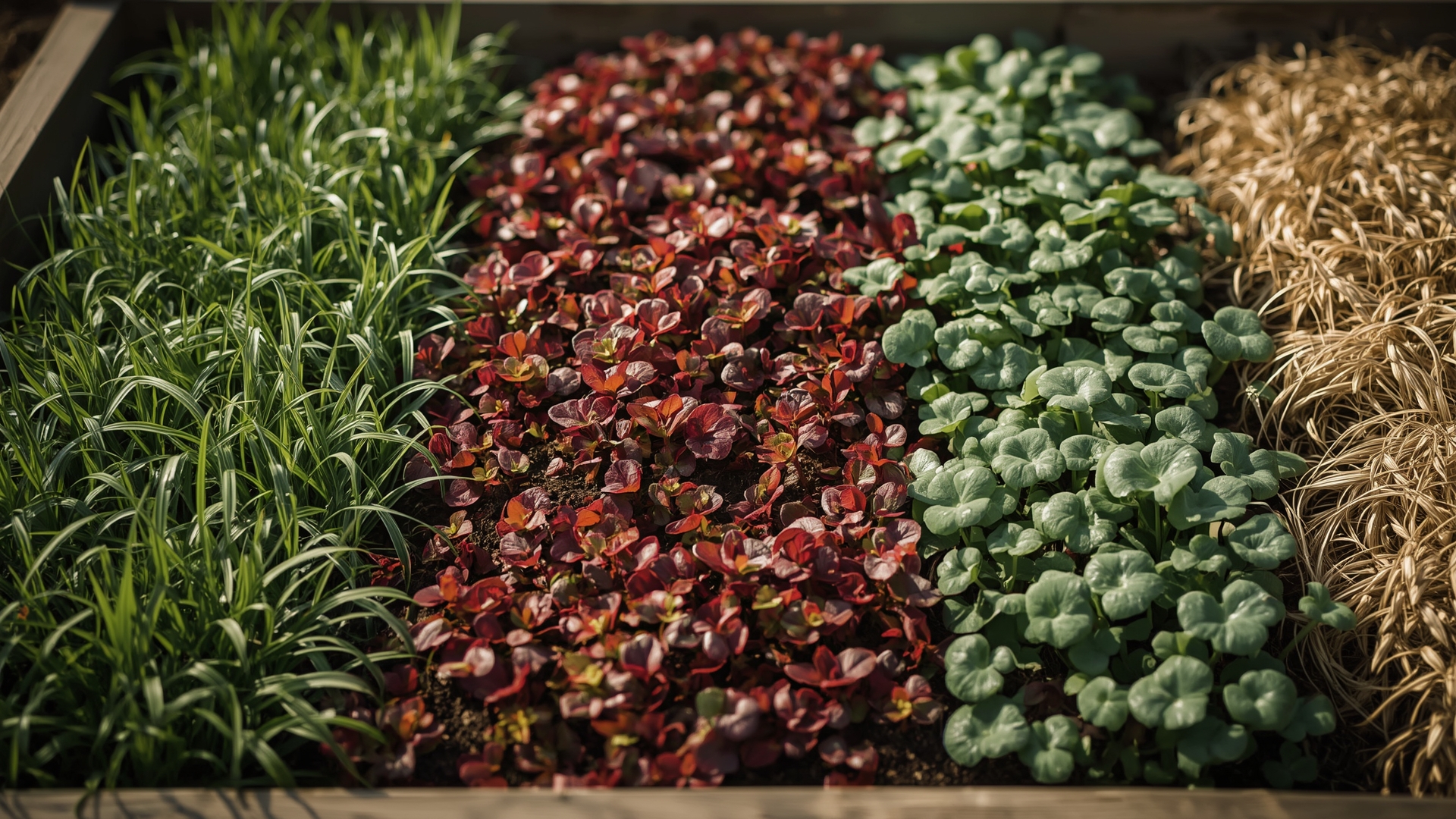
Quick Answer: Winter rye, crimson clover, buckwheat, and oats are the four most practical cover crops for home vegetable gardens. Each works best in a specific season. Your climate, bed size, and next vegetable crop determine which one fits your situation.
Winter Rye: The Cold-Climate Workhorse
Winter rye (Secale cereale) is the most reliable cool-season cover crop for home gardens. It germinates at soil temperatures as low as 34°F, establishes quickly, and survives hard freezes. You can seed it in late fall after pulling out tomatoes and peppers, and it will be actively growing before the ground freezes.
Its deep, fibrous roots penetrate 3–6 feet into the soil, breaking up compaction that no hand tool can reach. It also produces natural compounds called allelochemicals that suppress weed seed germination. This makes it especially effective if you struggled with weeds the previous season.
The main challenge with winter rye is termination. It grows vigorously and becomes hard to manage if you let it go to seed. Cut it down or till it under at least 3–4 weeks before planting vegetables.
Crimson Clover: The Nitrogen Builder
Crimson clover (Trifolium incarnatum) is a legume, which means it works with soil bacteria called Rhizobium to fix atmospheric nitrogen. A well-established stand of crimson clover can add 70–150 pounds of nitrogen per acre to the soil. At home-garden scale, that translates to meaningful reductions in fertilizer needs for your next crop.
It grows best in fall and spring. In mild winter climates (USDA Zones 6–9), it can overwinter and produce its striking red blooms in spring before you turn it under. In colder zones, treat it as a spring or early fall cover crop.
Inoculating crimson clover seed with Rhizobium bacteria before planting is worth the small extra cost. Pre-inoculated seed is available from most garden suppliers, or you can purchase inoculant separately and coat the seed yourself. Without inoculant, nitrogen fixation is unreliable.
Buckwheat: The Summer Gap Filler
Buckwheat (Fagopyrum esculentum) is not a grass or a legume. It’s a broadleaf plant in the same family as sorrel. It excels in warm-season gaps, such as the 6–8 weeks between spring crops and fall planting.
Buckwheat germinates in 5–7 days in warm soil and reaches full growth within 30–40 days. Its dense, quick canopy smothers weeds before they can establish. It also draws up phosphorus from deep in the soil profile and releases it near the surface when it decomposes, making it available to shallow-rooted vegetable crops.
One important rule: terminate buckwheat before it sets seed. Once it goes to seed, it can become a weed itself. Watch for the first white flowers and cut it down within a week.
Oats: The Easy Spring and Fall Option
Oats (Avena sativa) are a beginner-friendly cover crop. They establish quickly, grow densely enough to crowd out weeds, and winter-kill in most climates below USDA Zone 7. Winter-killing is actually a feature for home gardeners. A winter-killed oat cover crop leaves a dead mulch layer on the soil surface that you can plant directly through in spring with minimal bed prep.
Oats work well as a companion with crimson clover. The oats establish fast and support the slower-growing clover during the first few weeks. This combination is called a cover crop mix, and it gives you both biomass from the oats and nitrogen fixation from the clover.
Cover Crop Comparison Table
| Cover Crop | Best Season | Seeding Rate (per 100 sq ft) | Min Germination Temp | Days to Full Cover | Primary Benefit | Terminate Before |
|---|---|---|---|---|---|---|
| Winter Rye | Fall | 3–4 oz | 34°F | 21–28 days | Weed suppression, soil structure | Heading stage (before seed forms) |
| Crimson Clover | Fall / Spring | 0.5–1 oz | 40°F | 28–35 days | Nitrogen fixation | Early bloom (25–50% flowering) |
| Buckwheat | Summer | 2–3 oz | 50°F | 14–21 days | Weed smothering, phosphorus cycling | First flower appearance |
| Oats | Fall / Spring | 2–3 oz | 38°F | 21–30 days | Biomass, winter-kill mulch | Before heading (or let winter-kill) |
| Field Peas | Spring / Fall | 3–4 oz | 40°F | 21–28 days | Nitrogen fixation, biomass | Before full pod set |
When Should You Plant Cover Crops in a Vegetable Garden?
Quick Answer: Plant fall cover crops 4–6 weeks before your first expected frost so they establish before cold sets in. Plant summer cover crops like buckwheat right after pulling spring vegetables. Timing windows are narrow, so have seed on hand before your vegetable season ends.
Fall Planting Window
Fall is the most important cover crop season for most home gardeners. You have a clear gap after summer vegetables come out and before the ground freezes. The target window is typically late August through mid-October, depending on your location.
The goal is to get 4–6 weeks of growth before hard frost. That’s enough time for winter rye or oats to establish a root system that holds soil through winter. Clover needs the same window but benefits from soil temperatures still above 40°F for reliable germination.
If you miss the fall window, don’t panic. Winter rye can still be seeded very late (even into early November in some climates) and will germinate when soil temperatures rise above 34°F in early spring.
Spring Planting Window
Spring cover crops fill a different role. They protect soil while you’re waiting for temperatures to warm enough for warm-season vegetables. Oats and field peas are ideal here. Both tolerate light frost and grow quickly in cool spring conditions.
The challenge with spring cover crops is termination timing. You need to cut them down 2–4 weeks before transplanting tomatoes or peppers to give the organic matter time to begin decomposing. If you incorporate fresh green material too close to planting time, it can tie up soil nitrogen temporarily as it breaks down, which starves your seedlings.
Summer Planting Window
Summer gaps happen when spring crops are done and you’re waiting until late summer to plant fall vegetables. This window is often 6–10 weeks, which is enough time for two full buckwheat cycles if you terminate the first stand at flowering and re-seed.
Buckwheat is your primary tool here. It thrives in heat, requires minimal moisture once established, and delivers rapid weed suppression during the most weed-prone months of the gardening year.
How Do You Plant Cover Crops in a Home Garden Bed?
Quick Answer: Clear vegetable debris, loosen the top inch of soil, broadcast seed by hand across the entire bed, rake lightly to cover seed 0.25–0.5 inches deep, and water once. Most cover crops need minimal ongoing care until termination.
Bed Preparation Steps
- Remove vegetable residue. Pull spent plants, stakes, and cages. You don’t need to remove every root, but large plant debris interferes with even seed coverage.
- Break the surface crust. Rake or lightly loosen the top 1–2 inches of soil. You don’t need to till deeply. Cover crops establish from surface seeding.
- Broadcast seed evenly. Scatter seed by hand across the entire bed at the rate specific to your chosen cover crop. Use the rates in the comparison table above.
- Rake lightly. A gentle raking moves seed into contact with soil without burying it too deep. Target 0.25–0.5 inch depth for most species.
- Water the surface. A gentle watering settles seed into soil. Keep the surface moist for the first 7–10 days until germination is visible.
Seeding Rate Matters
Most beginner mistakes with cover crops involve under-seeding. A thin stand of cover crop is not much better than bare soil for weed suppression. Use the full recommended rate. Thick, overlapping growth is the goal.
For a standard 4×8 raised bed (32 square feet), you’ll use roughly 1–1.5 oz of winter rye, about 0.25 oz of crimson clover, or 0.75 oz of buckwheat. These amounts are small. A single seed packet covers multiple beds.
How Do You Terminate Cover Crops Before Planting Vegetables?

Quick Answer: Cut or till cover crops down 2–4 weeks before planting vegetables. Chop the stems at soil level, then turn the material into the top 4–6 inches of soil. Wait for the green material to begin composting before transplanting seedlings.
Termination Methods for Home Gardeners
You have three practical options at home-garden scale.
Cutting and composting: Mow or cut the cover crop at soil level with shears or a string trimmer. Remove the cut material and add it to your compost pile. Then rake the bed smooth and plant. This is the cleanest method for raised beds with defined borders.
Cutting and incorporating: Mow the cover crop, then use a garden fork or tiller to mix the cut material into the top 4–6 inches of soil. This adds organic matter directly to the bed. Allow 2–4 weeks before planting.
Crimping and mulching: For larger garden areas, you can crimp or roll cover crops to flatten them without fully cutting, then mulch over the top. This technique, common in no-till farming, can work at home scale for tomato transplants placed through the mulch layer. It’s more complex but preserves soil structure best.
The Nitrogen Tie-Up Problem
When you incorporate green plant material into soil, bacteria break it down. That process temporarily consumes soil nitrogen, pulling it away from plant roots. This is called nitrogen immobilization, and it can starve young seedlings if you plant too soon after incorporating cover crops.
The solution is simple: wait 2–4 weeks after incorporating before planting, especially if you’re adding large amounts of carbon-rich material like mature rye. Alternatively, cut the cover crop early (before it gets woody and tough) when it’s still young and soft. Young green material decomposes faster and causes less nitrogen tie-up.
How Do Cover Crops Fit Into a Vegetable Garden Rotation?
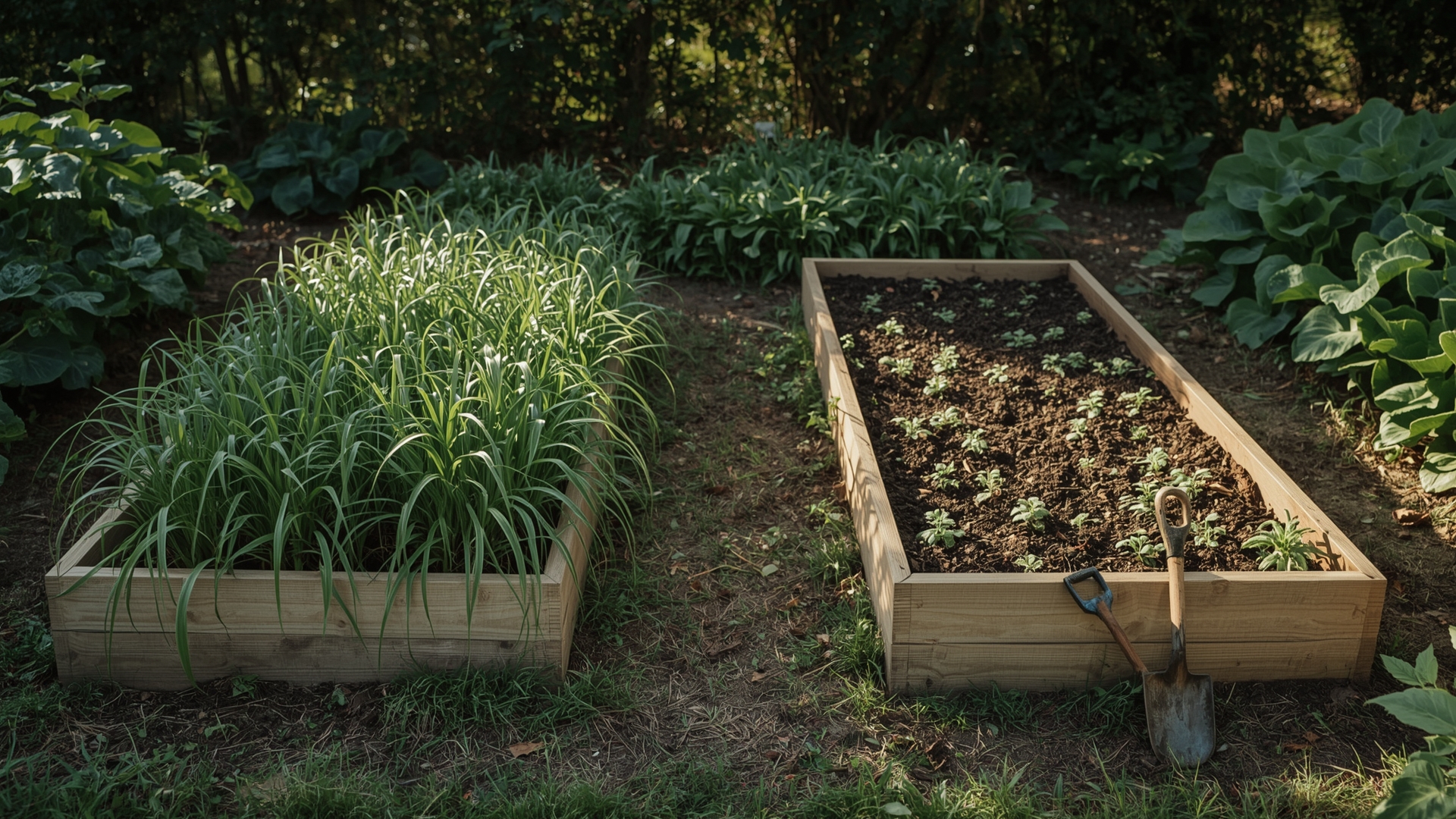
Quick Answer: Cover crops slot into the empty windows between vegetable crops in your rotation cycle. Plan one cover crop season per bed per year. Place nitrogen-fixing cover crops before heavy-feeding vegetables like corn, squash, or brassicas to reduce fertilizer needs.
A Simple 12-Month Rotation Template
| Month Range | Bed Activity | Notes |
|---|---|---|
| March – May | Spring vegetables (peas, lettuce, spinach) | Cool-season crops |
| June – July | Buckwheat cover crop | Fill summer gap after spring crops finish |
| August – October | Fall vegetables (tomatoes transplanted May, brassicas Aug) | Overlap timing based on your climate |
| Late October – November | Winter rye or oats seeded | 4–6 weeks before hard frost |
| December – February | Winter rye growing / overwintering | No maintenance needed |
| March (following year) | Terminate winter rye, prep for spring planting | Terminate 3–4 weeks before transplanting |
Pairing Cover Crops With the Right Vegetables
Nitrogen-fixing cover crops create a direct benefit when followed by nitrogen-hungry vegetables. Think of it as a two-act system. The cover crop builds nitrogen in the soil. The vegetable crop uses it.
The best pairings are straightforward. Plant crimson clover or field peas before corn, squash, brassicas (broccoli, cabbage, kale), or cucumbers. These vegetables consume nitrogen quickly and respond visibly to higher nitrogen levels with faster, darker growth.
Avoid planting nitrogen-fixing cover crops before legume vegetables like beans and peas. Legume vegetables make their own nitrogen. Excess nitrogen actually pushes them toward leaf growth at the expense of pod production.
Cover Crop and Vegetable Pairing Table
| Cover Crop | Best Followed By | Avoid Before | Nitrogen Added (lbs/1,000 sq ft) |
|---|---|---|---|
| Crimson Clover | Corn, squash, brassicas, cucumbers | Beans, peas | 1.6–3.4 lbs |
| Field Peas | Brassicas, tomatoes, leafy greens | Beans, edamame | 1.4–3.0 lbs |
| Winter Rye | Tomatoes, peppers, squash | Transplants planted immediately after | 0 (adds carbon, not nitrogen) |
| Buckwheat | Root vegetables, alliums | No restrictions | 0 (improves phosphorus availability) |
| Oats | Any vegetable after winter-kill | No restrictions | 0 (adds organic matter) |
What Soil Benefits Do Cover Crops Actually Deliver?
Quick Answer: Cover crops improve soil in four measurable ways: they increase organic matter by 0.1–0.5% per season, add up to 150 lbs of nitrogen per acre through fixation, reduce soil erosion by up to 90% compared to bare soil, and increase water-holding capacity by improving soil aggregation.
Organic Matter: The Foundation of Soil Health
Organic matter is the decomposed material from plants and animals that makes soil dark, crumbly, and productive. Most home garden soils start with 1–3% organic matter. Productive vegetable soil ideally sits above 5%.
Each cover crop cycle adds a layer of biomass to your soil. Over 3–5 seasons, you can see a meaningful change in soil color and texture. The soil becomes easier to dig, holds water longer between rains, and grows vegetables with less fertilizer input.
Soil Structure and Compaction Relief
Root systems are your primary tool for breaking compaction. Winter rye’s roots are particularly effective because they penetrate straight down through compacted layers that clay particles create as they pack together. When those roots die and decompose, they leave channels called biopores. Water and new roots from vegetable crops travel through those same channels.
Daikon radish, sometimes called a tillage radish, works similarly and deserves mention here even though it’s technically a vegetable. Many gardeners use it as a cover crop specifically for its deep, thick taproot (up to 18 inches) that fractures compacted subsoil layers.
Weed Suppression Mechanisms
Cover crops suppress weeds in two ways. Physical suppression happens when dense foliage blocks light, preventing weed seeds from germinating. Allelopathic suppression (the release of natural plant chemicals that inhibit weed growth) is specific to certain species, most notably winter rye and sorghum-sudangrass.
After you terminate a cover crop, the dead mulch layer continues to suppress weeds for several weeks. This residue period is particularly valuable in spring, when weed pressure is high and you’re still waiting for soil to warm before transplanting.
Do Cover Crops Work in Small Raised Beds?
Quick Answer: Yes. Cover crops work in raised beds as small as 4×4 feet. Scale down seeding rates proportionally. Focus on clover for nitrogen fixation in small beds. Winter rye can become difficult to manage in very small spaces due to its vigorous growth.
Adapting Cover Crops to Raised Bed Constraints
Raised beds have walls that define a clean edge. This actually makes cover cropping easier in some ways. There’s no risk of spreading into lawn areas, and you can cut the entire cover crop at once without worrying about irregular edges.
The main challenge in small raised beds is vigorous species like winter rye. A 4×8 bed filled with mature rye in spring can be dense and difficult to cut back by hand. In beds under 32 square feet, oats or clover are easier to manage. In larger raised beds (8×8 or bigger), rye is fine.
Raised Bed Cover Crop Sizing Guide
| Bed Size | Area (sq ft) | Recommended Cover Crop | Seed Needed | Management Note |
|---|---|---|---|---|
| 4×4 ft | 16 sq ft | Crimson clover or oats | 0.1–0.2 oz | Easiest to manage with hand shears |
| 4×8 ft | 32 sq ft | Oats or clover/oat mix | 0.2–0.4 oz | Winter rye manageable but vigorous |
| 4×12 ft | 48 sq ft | Winter rye or clover | 0.4–0.6 oz | All species practical at this scale |
| 8×8 ft or larger | 64+ sq ft | Any species including winter rye | Scale by table rates | String trimmer makes termination easy |
What Mistakes Do Gardeners Make With Cover Crops?
Quick Answer: The five most common mistakes are seeding too late, under-seeding, letting cover crops go to seed, planting vegetables too soon after incorporation, and choosing the wrong species for the season. Each mistake is easy to avoid once you know what causes it.
Seeding Too Late
If you plant a fall cover crop with fewer than 4 weeks before frost, it may germinate but won’t establish enough root mass to protect soil through winter. A thin, frosted cover crop is little better than bare soil. Mark your first average frost date and count backward 6 weeks to find your ideal seeding date.
Letting Cover Crops Mature and Seed
Every cover crop species becomes a weed problem if you let it go to seed. Buckwheat is the worst offender. It drops seeds quickly after flowering and germinates for years. Winter rye produces thousands of seeds per plant if it reaches maturity. Terminating at the right growth stage is the single most important management decision in cover cropping.
Planting Into Undecomposed Cover Crop Material
Fresh green plant material tied directly into soil consumes nitrogen as it decomposes. This creates a nitrogen deficit in the first 2–3 weeks after incorporation. Seedlings planted into this window show stunted growth and yellowing leaves. The fix is patience. Wait 3–4 weeks. The decomposition period ends, nitrogen is released back into the soil, and vegetable growth resumes normally.
Are Cover Crops Worth the Cost and Effort for Home Gardeners?
Quick Answer: Yes. A $5–$10 packet of cover crop seed treats 200–500 square feet of garden bed and delivers soil benefits that would cost $20–$40 in fertilizer and compost to replicate. The time investment is about 30 minutes per bed per season for seeding and termination.
The economics are straightforward. Crimson clover seed costs roughly $4–$8 per pound, and you need less than one ounce per 100 square feet. The nitrogen that one successful stand fixes is equivalent to applying about 1–2 pounds of balanced fertilizer per bed. Multiply that over 5–10 beds and the savings are meaningful.
The soil structure benefits are harder to put a price on. Better aggregated soil grows better vegetables. It requires less watering, resists compaction longer, and supports more robust beneficial microbial populations. Those effects compound year over year in a way that purchased amendments cannot replicate on the same timeline.
For a beginner, start with one cover crop in one or two beds for a single season. Buckwheat in a summer gap or oats in the fall. See the results firsthand. Most gardeners who try it once make cover cropping a permanent part of their rotation.
Frequently Asked Questions
Can you plant cover crops in the same bed as growing vegetables?
Yes, using a technique called interseeding or undersowing. You broadcast low-growing cover crops like white clover between vegetable rows after your main crop is established. The clover fills bare soil, fixes nitrogen, and dies back when you remove the vegetables. It works well with taller crops like tomatoes and brassicas.
How long does it take for cover crops to improve soil?
You’ll see measurable changes in soil texture and organic matter after 2–3 cover crop cycles. That typically means 2–3 years of consistent use. Nitrogen benefits from legume cover crops appear in the very next growing season after incorporation.
Do cover crops attract pests to my vegetable garden?
Most cover crops are not significant pest attractors. Clover can support aphid populations, but it also attracts beneficial insects like predatory wasps and ground beetles that feed on vegetable pests. The net effect is usually neutral to positive. Terminate cover crops before they flower to reduce insect habitat buildup near food crops.
Can you use cover crop seed from a feed store instead of a garden supplier?
Often yes. Field-grade winter rye, oats, and crimson clover from a farm or feed store work fine in vegetable gardens. The seed is usually cheaper per pound than garden-packaged seed. Just confirm the seed has not been treated with fungicide coatings, which are common in agricultural seed and not appropriate for food garden use.
What happens if you don’t terminate a cover crop before it sets seed?
The cover crop becomes a weed. Buckwheat, rye, and clover all self-seed aggressively. You may spend the next 1–2 seasons pulling volunteer plants from your vegetable beds. Always terminate at the vegetative or early-bloom stage, before seed heads form.
How do cover crops interact with soil microbes?
Cover crop roots release sugars and proteins called root exudates into the surrounding soil. These exudates feed bacteria and fungi in the soil food web, increasing microbial diversity and activity. More active soil microbes break down organic matter faster, cycle nutrients more efficiently, and support stronger vegetable root systems.